
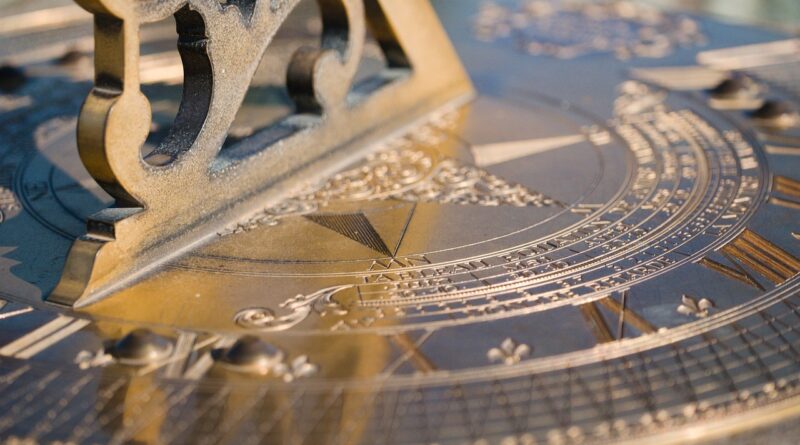
The Sundial – Ancient Timekeeping at Its Finest
Timekeeping has always been an essential part of human civilization, guiding daily activities, agricultural practices, and religious rituals. Among the earliest and most ingenious devices developed for this purpose is the sundial, a tool that uses the position of the sun to indicate the time of day.
The Invention of the Sundial
The origins of the sundial date back to ancient Egypt around 1500 BCE. Early sundials, known as shadow clocks, were simple devices with a vertical stick or obelisk that cast a shadow on a flat surface marked with lines indicating the hours of the day. These primitive devices evolved over time, becoming more sophisticated and accurate.
How Sundials Work
At its core, a sundial consists of a flat plate called a dial and a stick known as a gnomon, which casts a shadow on the dial. The position of the shadow on the marked dial indicates the time. The accuracy of a sundial depends on its alignment with the Earth’s rotational axis and the careful calibration of its hour lines.
Here’s a step-by-step overview of how a basic sundial operates:
- Alignment: The sundial must be aligned with true north in the northern hemisphere or true south in the southern hemisphere.
- Calibration: The hour lines on the dial are marked based on the geographic latitude of the sundial’s location.
- Shadow Casting: As the sun moves across the sky, the gnomon casts a shadow that moves around the dial.
- Time Indication: The position of the shadow on the hour lines indicates the current solar time.
The Evolution of Sundials
Over the centuries, sundials became more intricate, with various cultures adding their unique touches. The Greeks and Romans developed advanced sundials with more accurate hour lines and portable designs. In China and India, sundials were integrated into astronomical observatories for precise timekeeping and celestial observations.
One notable advancement was the development of the equatorial sundial, which featured a dial aligned parallel to the Earth’s equator. This design allowed for more accurate timekeeping throughout the year, as the hour lines remained consistent despite the changing seasons.
Impact on Early Civilizations
Sundials were not just practical tools; they held significant cultural and religious importance. In ancient Egypt, they were used to determine the timing of rituals and agricultural activities. The Greeks and Romans relied on sundials for daily scheduling and civic life. In medieval Europe, sundials adorned church walls and town squares, serving as public timekeepers.
The invention and widespread use of sundials represent a critical milestone in human history. They enabled ancient societies to measure time accurately, organize their lives, and develop complex calendars. Even today, sundials remain a symbol of human ingenuity and our enduring fascination with the passage of time.
The Legacy of the Sundial
While modern technology has largely replaced sundials for everyday timekeeping, their legacy lives on. Sundials can be found in gardens, parks, and historical sites worldwide, serving as beautiful reminders of our ancestors’ ingenuity and their quest to understand the natural world.
Whether you’re an enthusiast of ancient technology, a history buff, or someone who appreciates timeless craftsmanship, the sundial offers a fascinating glimpse into humanity’s journey to measure and master time.